
INVASIVE WEED MAPPING · ALBERTA & NE BC
You're spraying the thistle you can see.
We map the rest. Centimetre-resolution drone surveys that find every weed patch on a property — on pasture, rangeland, reclaimed land and rights-of-way across Alberta and northeast BC.
WHY TREATING WHAT YOU SEE DOESN'T FIX IT
The plants you don't find are the ones that decide next year.
Nobody walks a whole property, and nobody blanket-sprays one. What actually happens — on a grazing lease, along a right-of-way, down a road allowance — is that the ground near the tracks gets treated and the rest gets a guess. That is not carelessness. It is the only thing the time allows.
What that guess costs depends on the weed, because they are not all good at surviving in the same way. Broadly there are two strategies, and each beats a different half of how weeds normally get controlled.
Canada thistle, perennial sow thistle, hawkweed and common tansy creep outward from roots, rhizomes and stolons, and a fragment left behind starts a new patch. The established cores are a multi-year commitment whatever you do to them. What you can actually win is the new satellites — and they are small, scattered, and nowhere near the tracks.
Scentless chamomile, sweet clover and hawksbeard survive on sheer seed volume, and that seed stays viable in the soil for years — decades, in sweet clover's case. Here the whole game is reaching the plants before they set seed. A patch you drove past in July isn't this summer's problem; it's the next several summers'.
Different plants, opposite tactics — and both are beaten by the same gap. Whether a patch creeps or seeds, the ones that get away are the ones nobody looked at, because a field is searched from a vehicle along the ground somebody was already driving on.
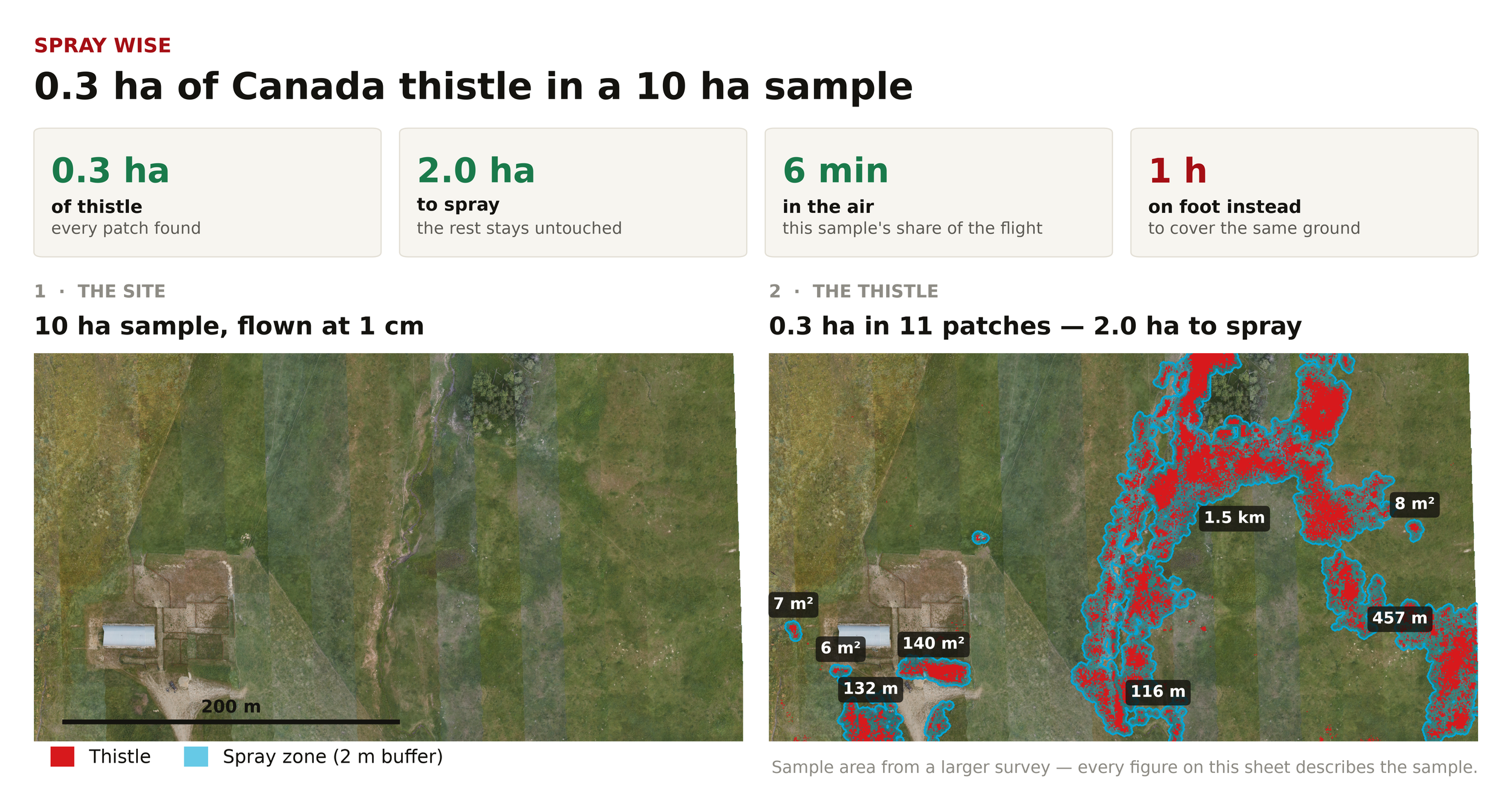
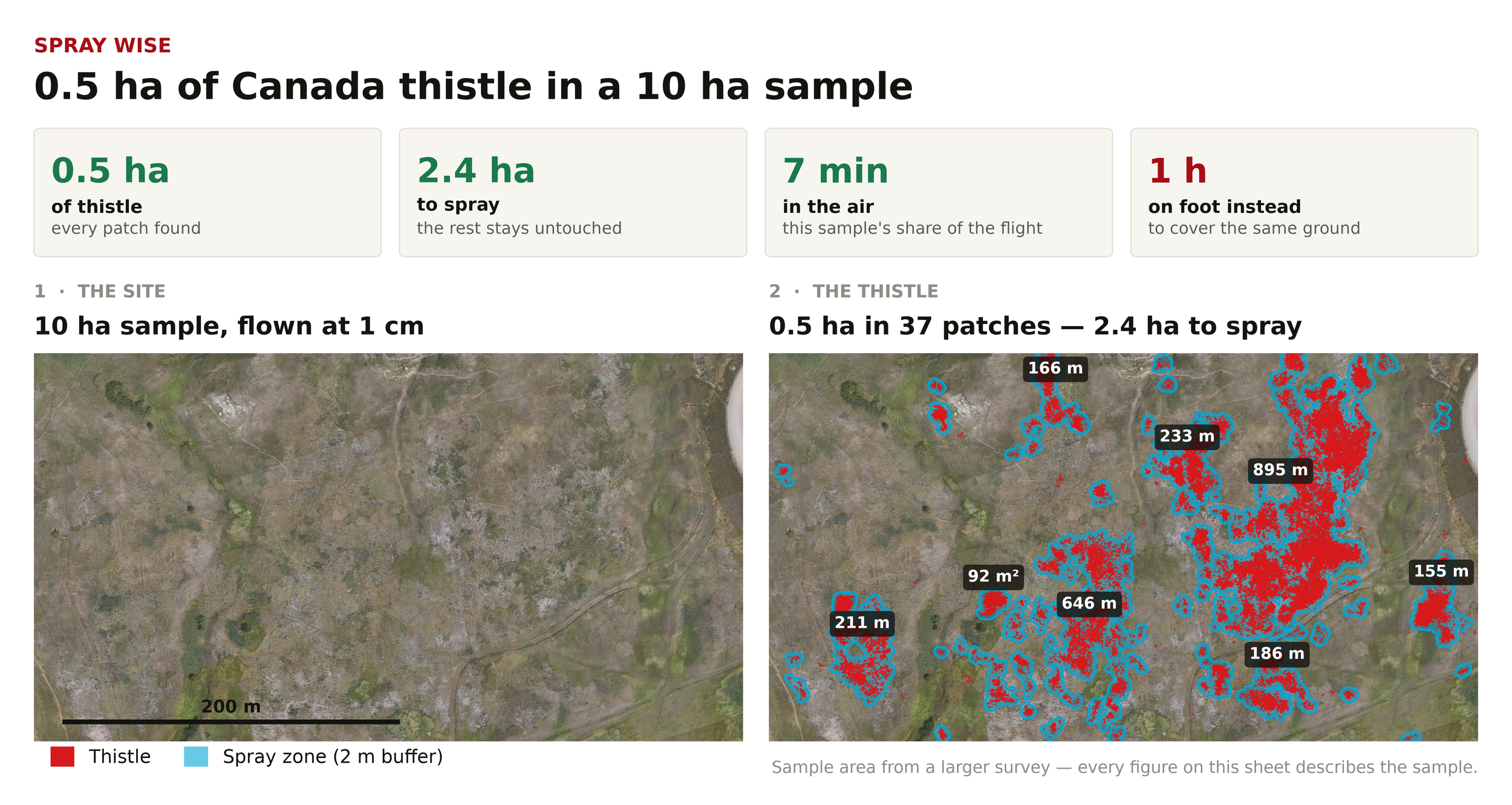
Canada thistle shows the shape of it. The large cores are a three-to-five year commitment whatever you do to them — you are not finishing those this season, and everyone who has fought them knows it. The satellites are the winnable part: on the 107 ha site we flew, 64% of patches were under five square metres, and together they held one to two percent of the thistle on the property. A few minutes each to treat. Small, scattered and off the tracks — precisely the part that never gets found.
So the current approach isn't slow. It's aimed at the wrong half. The species and the ground change from one property to the next; that pattern doesn't.
WHAT ONE FLIGHT FOUND
1.2 ha of thistle in 116 ha of ground.
One flight in August over a 116 hectare property, flown at 1 cm. Pasture, in this case, because that is where the 2026 season took us — but the survey does not care what the land is used for, and neither do the numbers. Canada thistle is the worked example because it is our most developed model; the method is the same whichever species you are chasing.
About one percent of the field. Every claim above follows from that ratio: once you know exactly where the one percent is, you never have to treat — or search — the other ninety-nine.
Below are two nine-hectare samples, one cut from that survey and one from a second property nearby, shown at full detail so the patches are actually legible. Each infestation is outlined, with a two-metre spray buffer drawn around it.
WHAT ONE FLIGHT FOUND
BUT CAN IT REALLY SEE A WEED?
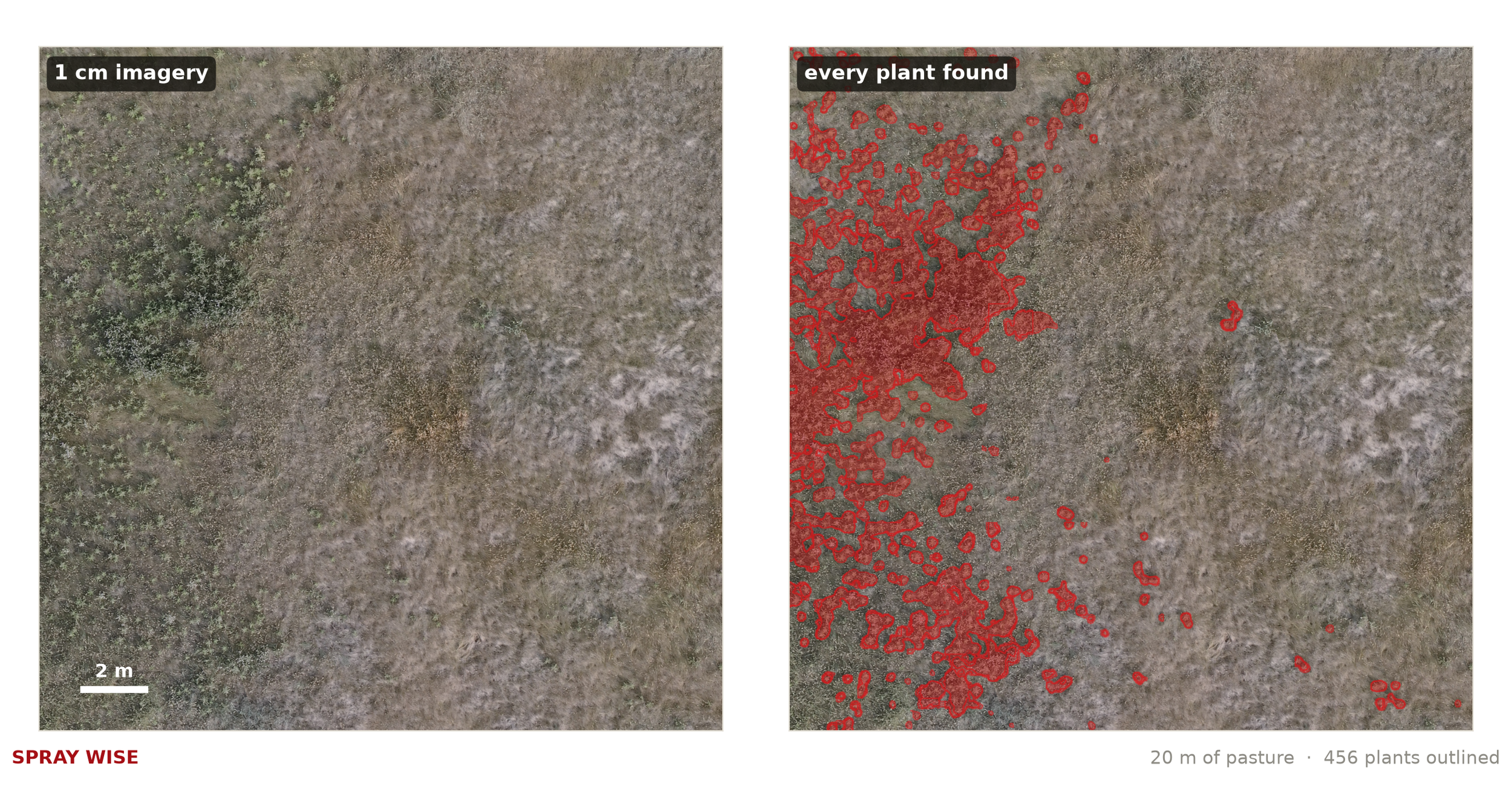
This is the same ground, twice.
A field-scale map proves coverage. It cannot prove detection — for that you have to zoom in far enough to see what the model is actually picking out of the sward. On the left is 1 cm imagery of open pasture. On the right is the same frame with every patch the model found outlined in red.
WHAT YOU RECEIVE
A map, a layer, and the numbers behind both.
Each infestation as a polygon with its area, so “there's thistle out there” becomes a figure you can put in a plan or a budget.
A buffered zone around each patch — the ground that needs treating, with the rest of the property left out of it. The figures label these “spray zone” because that is what the legend says; on county or reclaimed land the treatment may be something else.
Every patch carries a location, so a crew navigates to it instead of hunting for it. Files open in whatever your team already uses.
WHAT WE MAP
Six species, with the honest caveats attached.
Detection models developed out of research at the University of Calgary in collaboration with Falcon & Swift, each trained on the plant as it actually appears from the air at centimetre resolution. They are not interchangeable: what a species does to survive decides when it has to be flown, and what finding it early is actually worth. Between them they cover most of what turns up on pasture, on leases and rights-of-way, and along road allowances.
| Species | How it survives | What that means |
|---|---|---|
| Canada thistleCirsium arvense | Creeping rhizomes. A root fragment left behind starts a new patch. | Cores persist for years whatever you do. The winnable part is the new satellites — and they're the part that gets missed. |
| Perennial sow thistle, hawkweed & hawksbeardmapped as one class | Mixed, deliberately. Sow thistle and hawkweed creep from roots and stolons; hawksbeard is an annual that survives on seed volume alone. | Grouped for detection, not for agronomy — from the air they aren't reliably separable, but they don't behave alike on the ground. Telling them apart is a field call. |
| Scentless chamomileTripleurospermum inodorum | Prolific seed, and a seed bank that stays viable in the soil for years. | The flight has to land before seed set. A patch missed this summer is several seasons of follow-up. |
| Sweet cloverMelilotus spp. | Biennial with hard seed that persists for decades. First year vegetative, second year it flowers and seeds. | Timing is everything: it's the flowering year you need to catch. The species that matters most on reclaimed leases and rights-of-way. |
| DandelionTaraxacum officinale | Perennial taproot that regrows from the crown, plus wind-borne seed. | Flowers early, well before the others, so it usually needs its own pass. |
| Common tansyTanacetum vulgare — in development | Rhizomatous perennial forming dense colonies, often along water and road allowances. | Not offered as a service yet. See the partner-site callout below. |
BEFORE YOU CALL
Common Questions.
How big an area can you cover?
The properties behind the figures on this page were 107 and 116 hectares, each flown in a single flight of a little over an hour. It scales from one lease up to a portfolio of sites or a whole municipality, and larger areas get cheaper per hectare — most of the cost is getting there, not flying.
What does it cost?
Quoted by area and access. It varies enough between a single lease and a multi-site programme that a number printed here would mislead you more than it helped. Send the location and rough size and a fixed price comes back, usually within a day.
When do you need to fly?
It depends on the species — each has a window where it stands out from everything around it, and dandelion in particular sits well away from the others. Tell us what you're dealing with and we'll pick the window around it rather than flying whenever the calendar is free.
Can I put this in a reclamation or closure file?
You can put it in front of whoever is making the call, but understand what it is: a dated, geolocated record of what the model found on the day we flew. It is not a certification, and it does not make a determination — that stays with your QRS or your regulator. Where it earns its place is repetition, because two or three surveys of the same ground show a direction rather than a snapshot.
We're a county — can you cover road allowances and public parcels?
Yes, and scattered parcels are where the per-hectare cost argument works hardest, because most of what you pay for is mobilisation rather than flying. Tell us roughly how many parcels and how far apart, and the quote reflects the routing rather than treating each one as a separate job.
Can you tell me how much herbicide to use?
No. We map where the weed is and draw the zone that needs treating; the rate, the product and the plan belong to your agronomist or licensed applicator. What we're changing is the target, not the prescription.
Find out what's actually out there.
Ten-minute call, no cost. Tell us the ground and the species, and we'll tell you honestly whether flying it would show you something you don't already know.